

Introduction
Blockchain technology is not limited to cryptocurrencies like Bitcoin and Ethereum.
Different organizations and applications need different levels of decentralization, privacy, security, and control. Because of this, blockchain networks can be designed in different ways.
The four commonly discussed types of blockchain are:
- Public Blockchain
- Private Blockchain
- Consortium Blockchain
- Hybrid Blockchain
In this article, we’ll understand each type in simple terms and compare their differences.
What Is a Blockchain Network?
A blockchain is a distributed digital ledger that stores information across multiple computers called nodes.
Instead of depending on a single central database, blockchain technology can distribute records across a network.
However, not every blockchain gives everyone the same level of access.
This is what makes different blockchain types possible.
1. Public Blockchain
A public blockchain is a blockchain network that is generally open for anyone to participate in, subject to the network’s rules.

Anyone may be able to:
- View blockchain data
- Submit transactions
- Run a node
- Participate in network activities
The exact permissions depend on the specific blockchain.
Examples
Well-known public blockchains include:
- Bitcoin
- Ethereum
- Solana
Advantages
- High transparency
- Open participation
- Strong network effects
- No single organization necessarily controls the entire network
Disadvantages
- Can face scalability challenges
- Transaction fees can vary
- Some networks may consume significant energy
- Public data may not be suitable for sensitive business information
Common Uses
Public blockchains are commonly used for:
- Cryptocurrencies
- DeFi
- NFTs
- DAOs
- Web3 applications
2. Private Blockchain
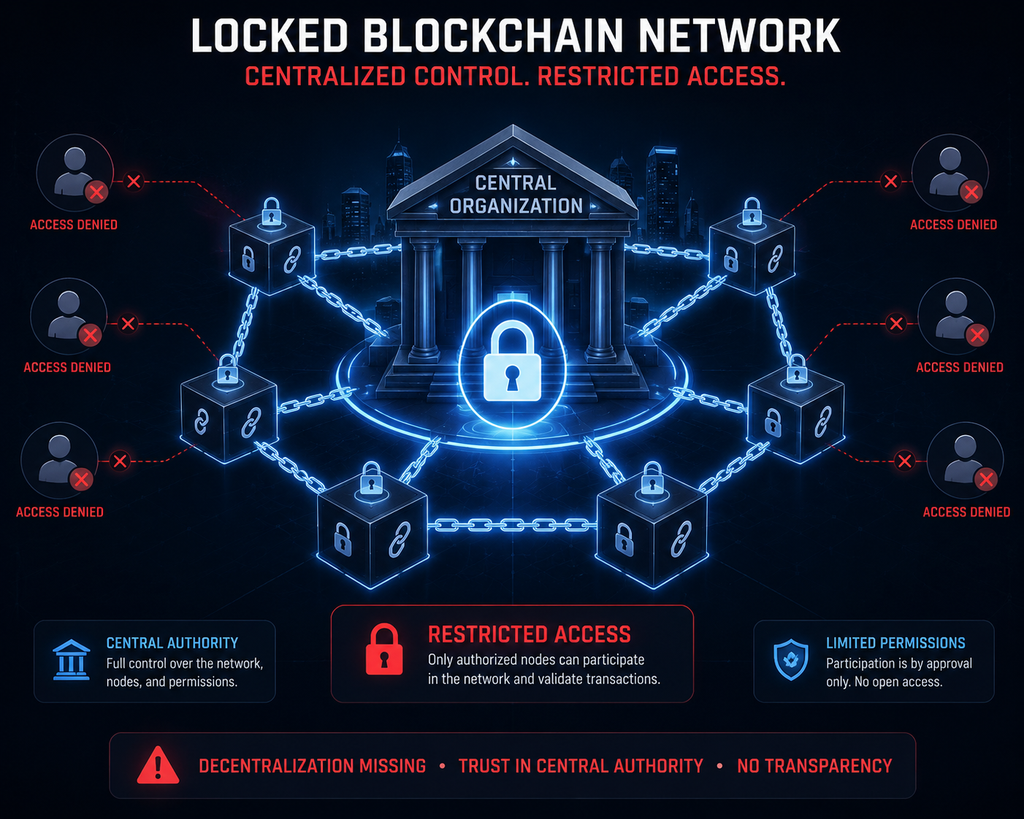
A private blockchain is a blockchain network where participation is controlled by a specific organization or administrator.
Unlike public blockchains, users generally need permission to access certain network functions.
For example, a company could create a blockchain network for its internal operations.
Advantages
- Greater control
- Restricted access
- Better privacy for certain business applications
- Potentially faster transaction processing
Disadvantages
- More centralized
- Requires an organization to manage the network
- Less open than public blockchains
Common Uses
Private blockchains can be considered for:
- Enterprise record management
- Internal business processes
- Supply-chain systems
- Auditing
- Data-sharing between authorized departments
3. Consortium Blockchain

A consortium blockchain is controlled by a group of organizations rather than a single organization.
Think of it as a shared blockchain network where several trusted organizations work together.
For example, multiple companies in the same industry could operate and govern a shared blockchain.
Advantages
- Shared control
- Better privacy than many public networks
- Can be more efficient for business processes
- Organizations can jointly manage network rules
Disadvantages
- Requires cooperation between organizations
- Less decentralized than a permissionless public blockchain
- Governance can become complicated
Common Uses
Consortium blockchain models can be useful for:
- Banking networks
- Supply chains
- Insurance
- Trade finance
- Inter-company data sharing
4. Hybrid Blockchain

A hybrid blockchain combines characteristics of public and private blockchain systems.
Some information or activities can be restricted, while selected information can be made publicly verifiable.
This provides organizations with a way to balance privacy and transparency.
Example
Imagine a company wants to keep customer information private but wants to make certain transaction records publicly verifiable.
A hybrid blockchain design could potentially support both requirements.
Advantages
- Flexible access control
- Can combine privacy with transparency
- Suitable for applications with different data-access requirements
Disadvantages
- More complex architecture
- Requires careful access-control design
- Not as open as a fully public blockchain
Public vs Private vs Consortium vs Hybrid
| Feature | Public | Private | Consortium | Hybrid |
|---|---|---|---|---|
| Access | Generally open | Restricted | Restricted to participating organizations | Mixed |
| Control | Distributed | Single organization | Multiple organizations | Depends on design |
| Transparency | High | Limited | Controlled | Selective |
| Privacy | Lower | Higher | Higher | Flexible |
| Decentralization | Generally high | Lower | Medium | Varies |
| Main Use | Crypto & Web3 | Enterprise | Multi-organization | Mixed applications |
Simple Example
Let’s understand the four types using a simple example.
Public Blockchain
Imagine a public park.
Anyone can enter and participate according to the rules.
Private Blockchain
Imagine a company office.
Only authorized people can enter.
Consortium Blockchain
Imagine several companies sharing one business network.
Each participating organization has a role in managing the system.
Hybrid Blockchain
Imagine a building with public and restricted areas.
Some information is accessible to everyone, while other areas require permission.
Which Blockchain Type Is Best?
There is no single blockchain type that is best for every situation.
The choice depends on the application’s requirements.
Choose a Public Blockchain When:
You need:
- Open participation
- High transparency
- Decentralized applications
- Public verification
Choose a Private Blockchain When:
You need:
- Restricted access
- Organizational control
- Private business data
- Permissioned participation
Choose a Consortium Blockchain When:
Several organizations need to:
- Share data
- Collaborate
- Jointly manage a network
- Maintain controlled access
Choose a Hybrid Blockchain When:
You need a combination of:
- Privacy
- Transparency
- Controlled access
- Public verification
Are Private Blockchains Really Decentralized?
Not necessarily.
A major difference between public and private blockchains is who has control over participation and governance.
A private blockchain may use distributed infrastructure while still being governed by a single organization.
Therefore, simply using blockchain technology does not automatically make a system fully decentralized.
Why Are There Different Types of Blockchain?
Different applications have different requirements.
A cryptocurrency network may prioritize:
Decentralization + Security + Open Participation
A business network may prioritize:
Privacy + Performance + Access Control
A multi-company network may prioritize:
Shared Governance + Privacy + Collaboration
Different blockchain architectures exist because these requirements are not always the same.
Frequently Asked Questions
What are the four main types of blockchain?
The commonly discussed types are Public, Private, Consortium, and Hybrid blockchains.
Is Bitcoin a public blockchain?
Yes. Bitcoin operates as a public, permissionless blockchain network.
Is Ethereum a public blockchain?
Yes. Ethereum is a public blockchain network.
Which blockchain is best for businesses?
It depends on the business requirements. Private, consortium, or hybrid designs may be appropriate when organizations need controlled access and privacy.
Is a private blockchain decentralized?
It can distribute data and processing across multiple nodes, but governance may remain under the control of one organization.
What is the difference between public and private blockchain?
A public blockchain generally allows open participation, while a private blockchain restricts participation to authorized users.
Conclusion
Blockchain technology comes in different forms, and each type has its own strengths and limitations.
The four major types can be remembered as:
Public → Open
Private → Controlled
Consortium → Shared Control
Hybrid → Flexible
Understanding these blockchain types is an important step toward learning more advanced concepts such as smart contracts, Web3, Layer 1, Layer 2, DeFi, and decentralized applications.