
Introduction
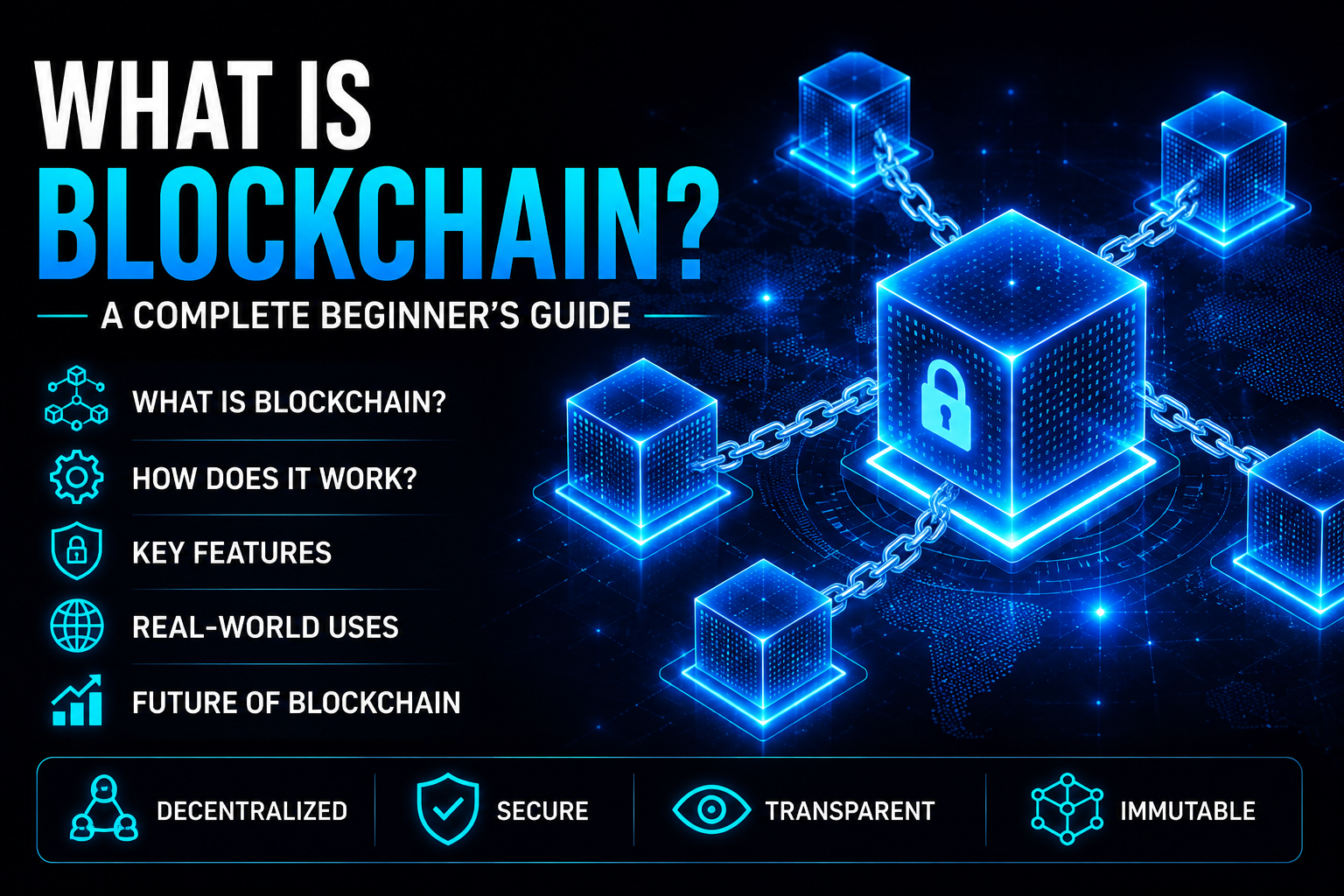
Blockchain is one of the most important technologies behind the growth of cryptocurrency, Web3, decentralized applications, and digital assets.
But what exactly is blockchain?
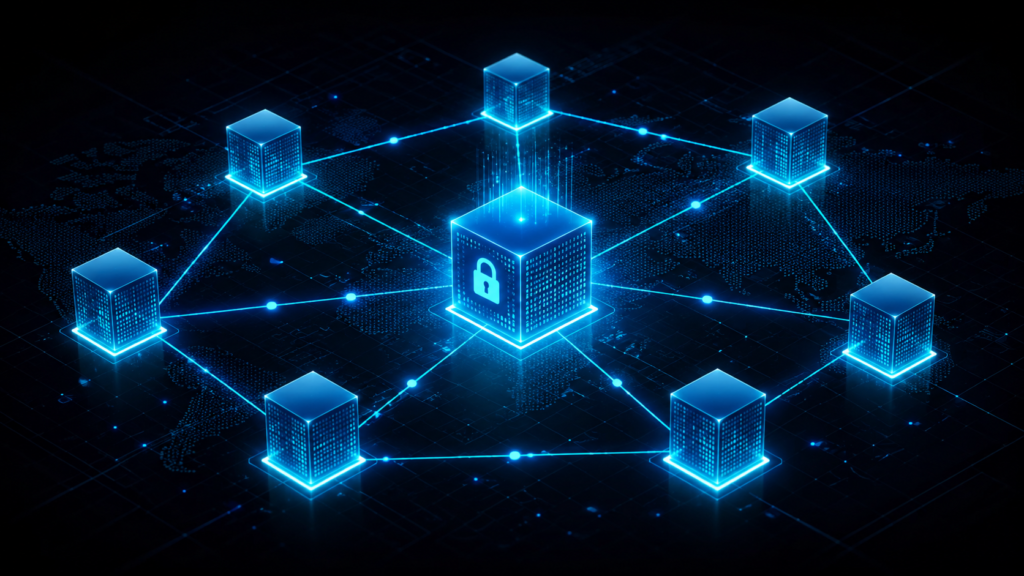
In simple terms, blockchain is a digital system that records information in a secure, transparent, and decentralized way. Instead of keeping data in one central database, blockchain distributes copies of the data across a network of computers.
This technology can be used for much more than cryptocurrency. From financial services and supply chains to digital identity and asset tokenization, blockchain is being explored across many industries.
In this guide, we will understand what blockchain is, how it works, its main features, advantages, limitations, and real-world applications.
What Is Blockchain?
A blockchain is a type of distributed ledger technology (DLT) that stores information in a series of connected blocks.
Each block can contain information such as:
- Transaction details
- A timestamp
- A unique cryptographic hash
- The hash of the previous block
Because each block is connected to the previous one, changing information in an earlier block can affect the entire chain.
The ledger is also distributed across multiple computers, commonly called nodes. This means there is not necessarily one central server controlling the complete database.
Simple Example
Imagine a notebook shared by 1,000 people.
Whenever someone adds a new transaction, the network verifies it and records it in the notebook. Everyone maintains a copy.
If someone tries to secretly change an old entry, the other copies can reveal that the information does not match.
This is the basic idea behind a distributed blockchain ledger.
How Does Blockchain Work?
Blockchain technology may look complicated, but its basic process can be understood in a few steps.
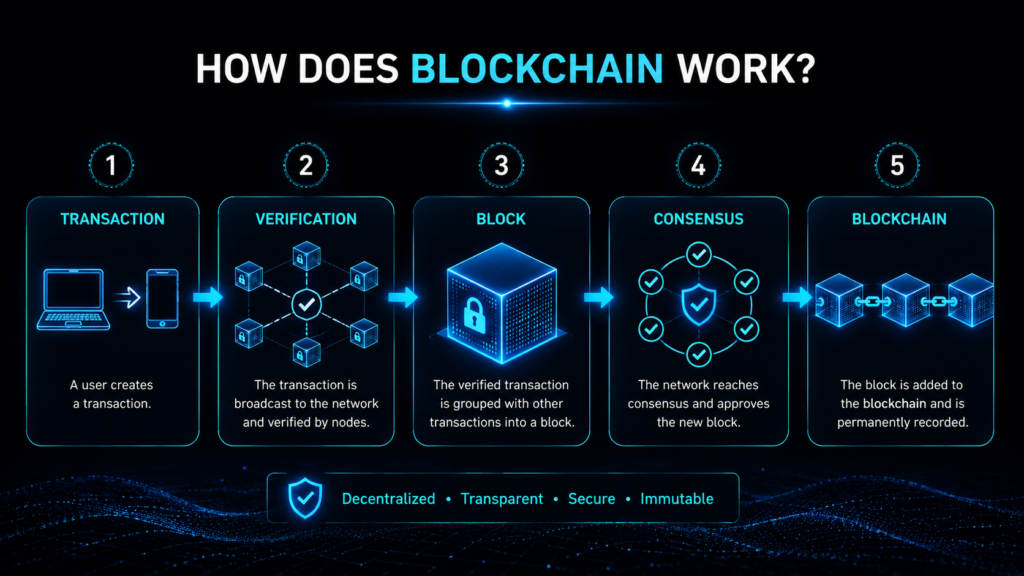
1. A Transaction Is Created
A user starts a transaction.
For example:
Alice wants to send digital assets to Bob.
The transaction contains information about the sender, receiver, and amount.
2. The Transaction Is Broadcast to the Network
The transaction is sent to computers participating in the blockchain network.
These computers are called nodes.
3. The Network Verifies the Transaction
The blockchain uses a consensus mechanism to determine whether the transaction is valid.
Different blockchains can use different consensus mechanisms, such as:
- Proof of Work
- Proof of Stake
- Other consensus models
4. Transactions Are Added to a Block
Once transactions are verified, they can be grouped together into a block.
The block contains information that allows it to be connected to the existing blockchain.
5. The Block Is Added to the Blockchain
After the network accepts the block, it becomes part of the chain.
The updated ledger is then distributed across participating nodes.
What Is a Block?
A block is essentially a container that stores information on a blockchain.
A typical block can include:
Block Data
This contains the information being recorded, such as transactions.
Timestamp
This records when the block was created.
Hash
A hash is a cryptographic representation of information.
Even a small change in the underlying data can produce a very different hash.
Previous Block Hash
The block can reference the hash of the previous block.
This connection helps create the blockchain structure.
What Is a Blockchain Node?
A node is a computer that participates in a blockchain network.
Depending on the blockchain and node type, a node may help:
- Store blockchain data
- Verify transactions
- Propagate information
- Participate in consensus
Instead of relying on one central computer, blockchain networks can distribute responsibilities across many computers.
What Makes Blockchain Different?
Blockchain has several important characteristics.
1. Decentralization
Traditional databases are often controlled by a central organization.
Blockchain networks can distribute control and data across multiple participants.
2. Transparency
On many public blockchains, transaction information can be viewed publicly.
However, the exact information visible depends on the blockchain and its privacy design.
3. Immutability
Blockchain records are designed to be difficult to alter after they have been accepted by the network.
This does not mean that every blockchain is absolutely impossible to change. Rather, properly secured blockchain records can make unauthorized modification extremely difficult.
4. Security
Cryptography, consensus mechanisms, and distributed network architecture work together to help protect blockchain data.
5. Traceability
Blockchain records can create a chronological history of transactions or other data.
This can be useful for tracking assets and verifying records.
Blockchain vs Traditional Database
| Feature | Blockchain | Traditional Database |
|---|---|---|
| Control | Often distributed | Usually centralized |
| Data structure | Blocks linked together | Tables/documents/other structures |
| Transparency | Can be publicly verifiable | Usually controlled by owner |
| Modification | Designed to resist unauthorized changes | Authorized users can modify data |
| Consensus | Often required | Usually not required between independent nodes |
| Typical use | Digital assets, decentralized systems | Business applications, websites, apps |
Blockchain is not automatically better than a traditional database.
For many applications, a conventional database can be faster, simpler, and cheaper.
Blockchain becomes particularly interesting when multiple parties need to share and verify records without relying entirely on one central authority.
Where Is Blockchain Used?
Blockchain technology has applications beyond cryptocurrency.
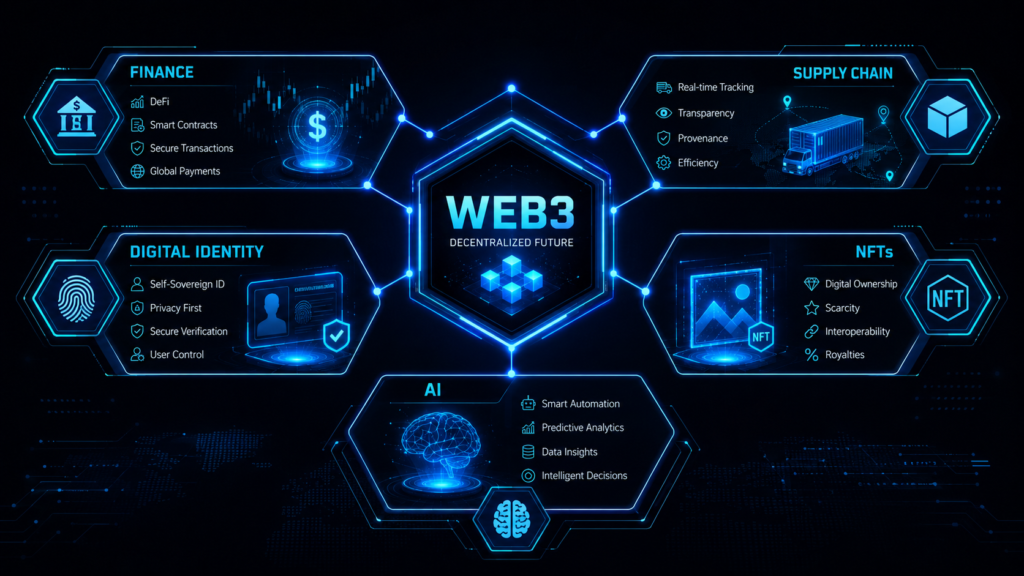
💰 Financial Services
Blockchain can support digital payments, settlement systems, tokenized assets, and other financial applications.
📦 Supply Chain
Companies can explore blockchain for tracking products and recording events throughout a supply chain.
🪪 Digital Identity
Blockchain-based identity systems can give users different ways to manage and verify digital credentials.
🎨 NFTs
Non-fungible tokens can represent unique digital or physical assets on supported blockchain networks.
🤖 AI + Blockchain
Blockchain can potentially help with areas such as data provenance, decentralized coordination, identity, and digital ownership.
🏠 Real-World Asset Tokenization
Blockchain can be used to represent ownership or claims associated with certain real-world assets in digital form.
Advantages of Blockchain
Blockchain technology offers several potential benefits:
- Decentralization can reduce dependence on a single central database.
- Transparency can make certain records easier to independently verify.
- Security is supported by cryptography and distributed architecture.
- Traceability can help track transactions and assets.
- Programmability allows smart contracts to automate certain processes.
- Global accessibility allows internet-connected participants to interact with many public blockchain networks.
Limitations of Blockchain
Blockchain also has challenges.
Scalability
Some blockchain networks can face limitations when transaction demand becomes very high.
Transaction Costs
Depending on the network, transaction fees can increase during periods of high activity.
Complexity
Blockchain concepts such as private keys, wallets, smart contracts, and consensus can be difficult for beginners.
Energy Usage
Some consensus mechanisms, particularly Proof of Work, can require significant computational resources.
Regulation
Blockchain and digital assets operate in a rapidly evolving regulatory environment.
Is Blockchain the Same as Cryptocurrency?
No.
Cryptocurrency is one application of blockchain technology.
For example, blockchain networks can be used to record digital asset transactions, but blockchain itself is a broader technology.
Other potential applications include:
- Supply chain tracking
- Digital identity
- Tokenization
- Smart contracts
- Decentralized applications
- Data verification
Think of it this way:
Blockchain = Technology
Cryptocurrency = One application of that technology
What Is the Future of Blockchain?
Blockchain development is moving beyond the original idea of digital currencies.
Some areas receiving significant attention include:
- Real-world asset tokenization
- Layer 2 scaling
- Zero-knowledge proofs
- Decentralized identity
- DePIN
- AI and blockchain
- Privacy-focused blockchain systems
- Blockchain-based financial infrastructure
The technology is still evolving, and not every blockchain project will succeed.
The long-term impact of blockchain will depend on whether it can solve real-world problems more effectively than existing technologies.
Conclusion
Blockchain is a distributed ledger technology designed to record and verify information across a network.
Its combination of cryptography, distributed systems, and consensus mechanisms makes it useful for applications where transparency, verification, digital ownership, or reduced dependence on a central intermediary are important.
Cryptocurrency was one of blockchain’s first major applications, but the technology has expanded into areas such as Web3, smart contracts, NFTs, digital identity, AI, and asset tokenization.
As blockchain technology continues to evolve, understanding its fundamentals is an important first step for anyone interested in Web3, cryptocurrency, or decentralized technology.
Keep learning. Keep exploring. Welcome to ChainTalk. 🚀