
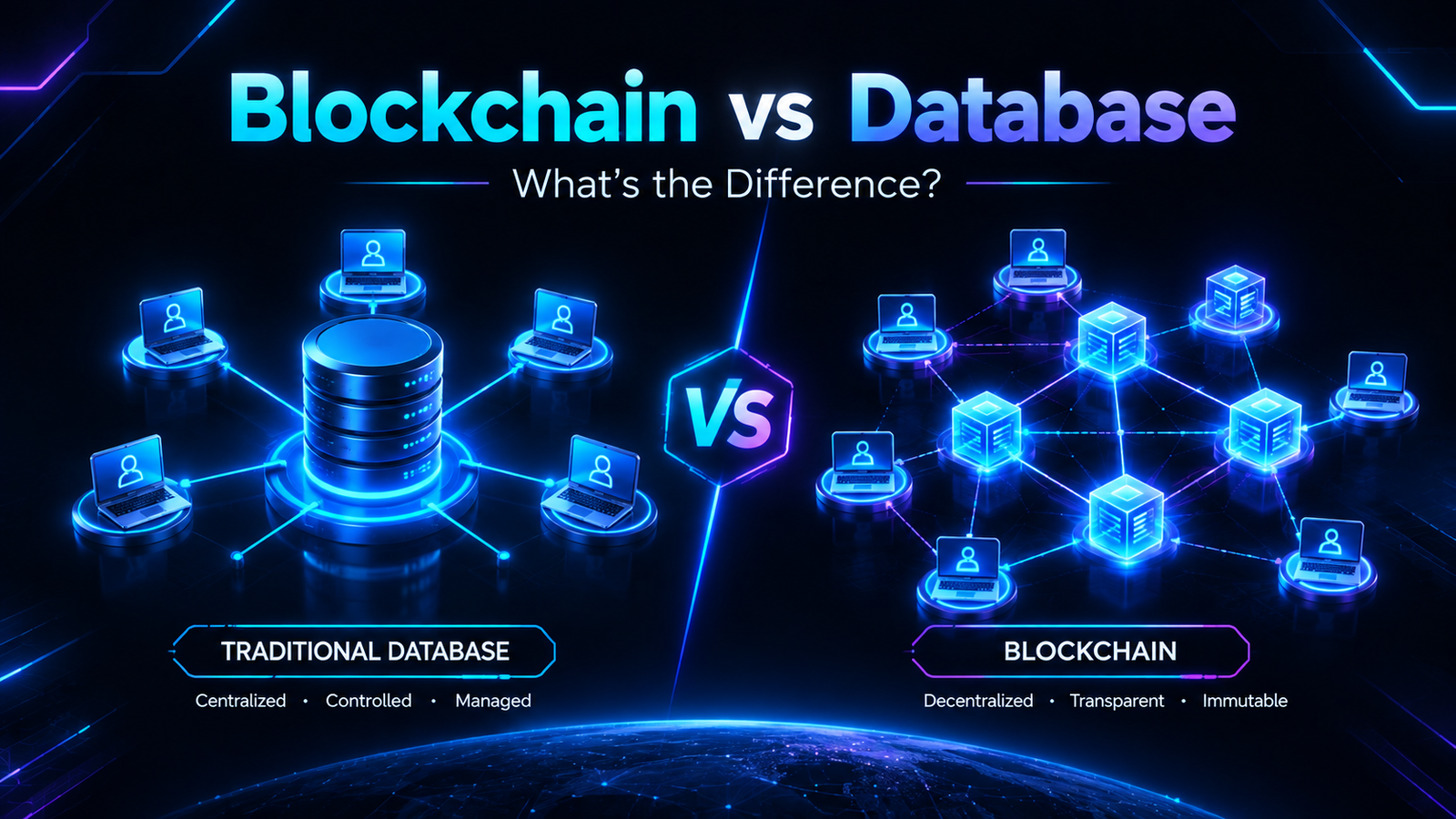
Focus Keyword: blockchain vs traditional database
Meta Description: Discover the key differences between blockchain and traditional databases, including data storage, security, transparency, control, and real-world use cases.
Introduction
Data is one of the most important parts of modern technology. Almost every website, mobile application, bank, business, and online service uses a database to store and manage information. Traditional databases have been used for decades and are extremely efficient. However, blockchain technology has introduced a different approach to storing and sharing data.
Blockchain and traditional databases can both store information, but they are designed for different purposes. A traditional database normally depends on a central organization or administrator, while a blockchain can allow multiple participants to maintain a shared record without relying on one central authority.
Understanding the difference between blockchain and traditional databases is important for anyone learning about Web3, cryptocurrency, and decentralized applications.
What Is a Traditional Database?
A traditional database is a structured system used to store, organize, and retrieve information. Companies use databases to manage customer information, product details, financial records, orders, employee information, and much more.
For example, when you purchase something from an online shopping website, information such as your order, payment status, and delivery details may be stored in a database.
Most traditional databases are controlled by an organization. The organization decides who can access the database, who can modify information, and how the data is managed.
Popular database technologies include SQL databases, relational databases, and NoSQL databases.
What Is Blockchain?
Blockchain is a type of distributed digital ledger. Instead of keeping the complete record in one central location, blockchain networks can distribute copies of the ledger across multiple computers called nodes.
Transactions are grouped into blocks. These blocks are connected using cryptographic techniques, creating a chain of records.
Depending on the blockchain, participants can verify transactions through a consensus mechanism. Once information is added to a blockchain, changing historical records can be difficult because changes would need to be accepted according to the network’s rules.
This design makes blockchain useful for applications where transparency, shared verification, and decentralization are important.
Blockchain vs Traditional Database
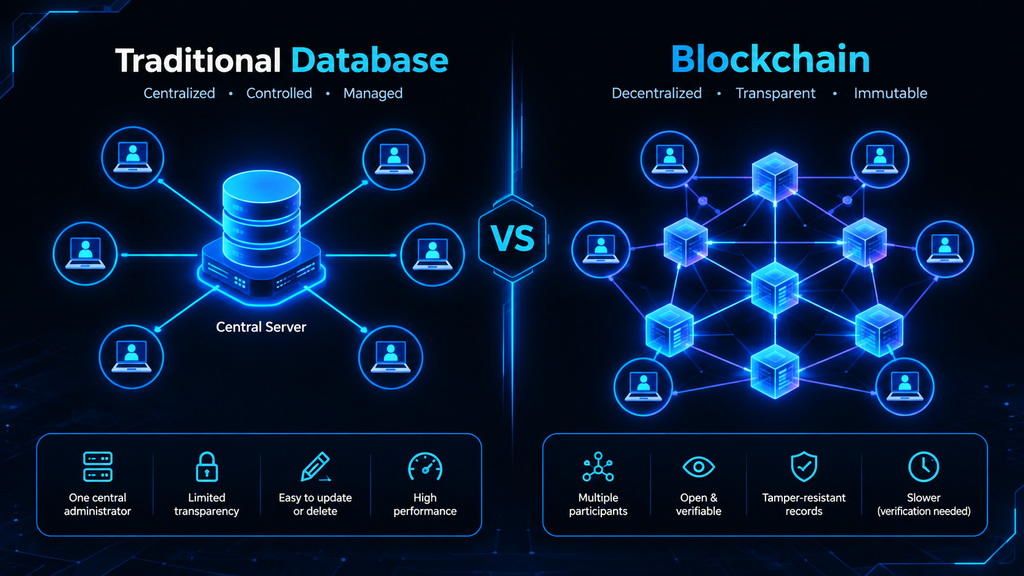
The biggest difference is how data is controlled and managed.
In a traditional database, one organization or administrator usually has control over the system. In a blockchain network, control can be distributed among multiple participants.
A traditional database can allow an authorized administrator to directly update or delete information. Blockchain systems generally record transactions in a way that makes historical changes much more difficult.
Another important difference is transparency. A traditional database may be completely private, while some blockchains allow participants to independently verify the records stored on the network.
Centralization vs Decentralization
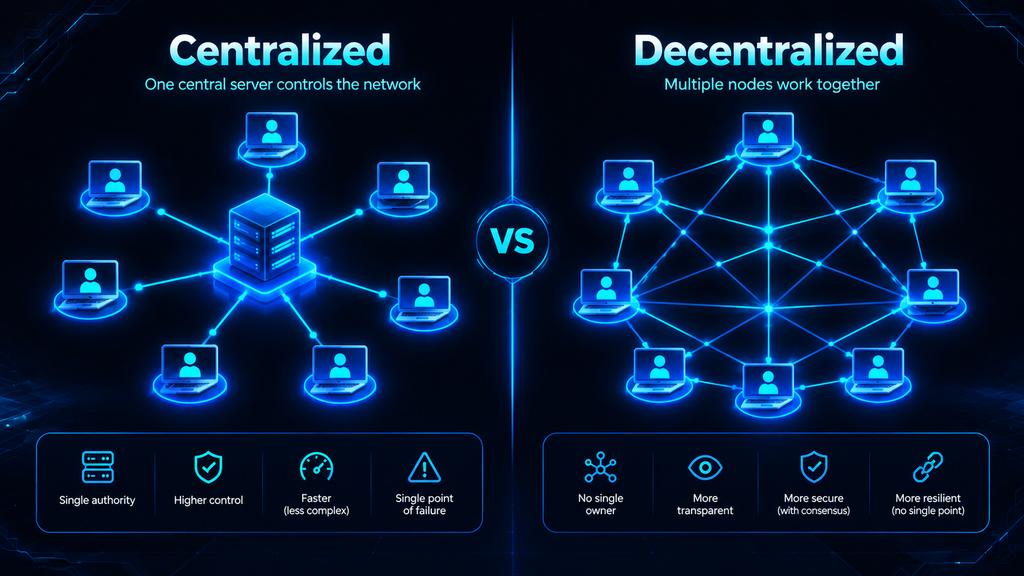
Traditional databases are commonly centralized. This means a central organization manages the database and controls access.
For example, a bank maintains databases containing account and transaction information. Customers can access their information, but the bank manages the underlying system.
Blockchain can use a decentralized architecture. Multiple nodes can maintain copies of the ledger and participate in transaction verification.
However, not every blockchain is completely decentralized. Different blockchain networks can have different levels of decentralization.
Data Modification
Data modification is another major difference.
Traditional databases are designed to make updating information easy. An administrator can update a customer’s address, change an order status, or correct a record.
Blockchain focuses more on maintaining a verifiable history of transactions. Instead of simply replacing an old record, a new transaction can be recorded to represent a change.
This can provide a strong audit trail, although it can also make blockchain less convenient when frequent data modification is required.
Speed and Performance
Traditional databases are generally very fast for applications that require frequent reading and writing of data.
For example, social media platforms, online stores, and business applications may need to process thousands or millions of database operations.
Blockchain networks can have additional processing requirements because transactions may need to be verified and agreed upon by network participants.
Therefore, blockchain is not automatically better than a traditional database when speed is the main requirement.
The correct technology depends on the application’s needs.
Security
Both technologies can be secure when properly designed, but they use different approaches.
Traditional databases can use passwords, authentication systems, access controls, encryption, backups, and monitoring to protect information.
Blockchain uses cryptographic methods, digital signatures, consensus mechanisms, and distributed network architecture.
However, blockchain does not mean that everything is automatically secure. Smart-contract bugs, stolen private keys, vulnerable applications, and poor implementation can still create security problems.
Transparency
Transparency is one of blockchain’s major advantages.
On many public blockchains, transaction information can be independently viewed and verified. This can be useful for applications where participants need to trust a shared record.
Traditional databases can also provide transparency to authorized users, but the database owner controls what information is accessible.
Therefore, blockchain can be particularly useful when several independent parties need access to a common record.
When Should You Use a Traditional Database?
A traditional database may be the better choice when:
- One organization controls the application.
- Data needs frequent updates.
- High performance is required.
- Access must remain private.
- The application does not require decentralization.
- A trusted administrator already exists.
For example, a school management system or company’s employee database may work very well with a traditional database.
When Should You Use Blockchain?
Blockchain can be useful when:
- Multiple parties need a shared record.
- Participants do not want complete dependence on one central authority.
- Transaction history needs to be verifiable.
- Transparency is important.
- Digital assets or tokens are involved.
- Smart contracts are required.
- Decentralized applications are being developed.
Examples include cryptocurrency networks, decentralized finance, digital ownership systems, supply-chain tracking, and decentralized identity.
A Simple Example
Imagine a college maintains student attendance.
With a traditional database, the college’s server stores the attendance records. Authorized staff can update the records when necessary.
With a blockchain-based system, attendance transactions could be recorded on a shared blockchain. Authorized participants could verify the history of records according to the network’s rules.
The blockchain approach could provide stronger traceability, but it may also introduce additional complexity and cost.
Therefore, using blockchain simply because it is newer does not automatically make it the better solution.
Conclusion
Blockchain and traditional databases are both powerful technologies, but they solve different problems.
Traditional databases are excellent for fast, centralized, and easily editable data management. Blockchain is useful when decentralization, shared verification, transparency, and tamper-resistant history are important.
The future is unlikely to be about blockchain completely replacing traditional databases. Instead, both technologies can work together. A modern application may use a traditional database for large amounts of everyday data while using blockchain for transactions, ownership records, or verification.
Understanding when to use each technology is one of the most important steps in learning blockchain and Web3.
In simple words:
Traditional Database → Centralized + Fast + Easily Editable
Blockchain → Distributed + Verifiable + Tamper-Resistant