
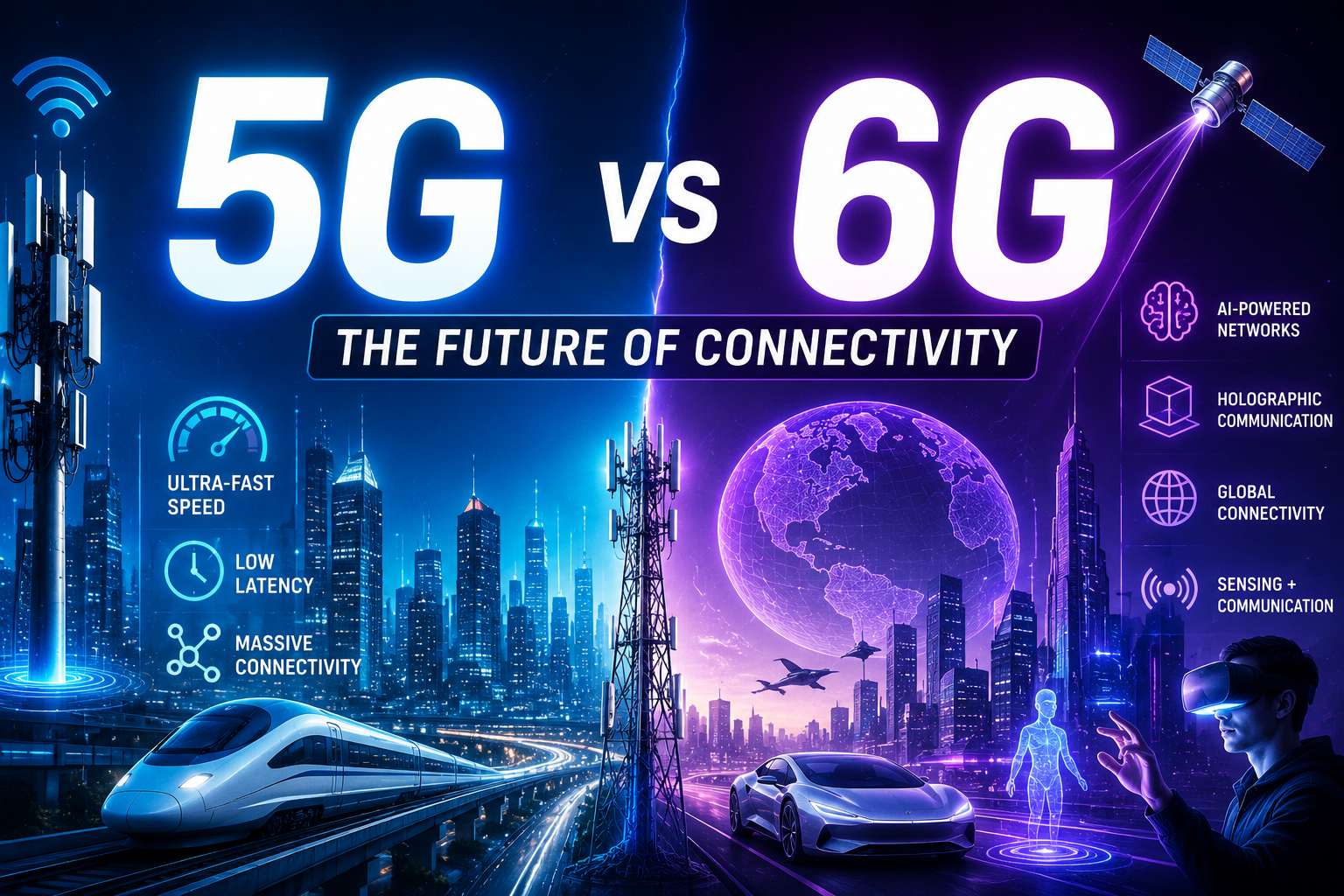
Introduction
The world is becoming increasingly connected every day. From smartphones and smart homes to autonomous vehicles and industrial automation, modern technologies depend on fast, reliable, and efficient communication networks. Over the past few decades, mobile network technology has evolved significantly, transforming the way people communicate, work, learn, and entertain themselves. The introduction of 5G marked a major milestone in this journey, offering unprecedented speed, low latency, and massive connectivity.
However, technology never stands still. While 5G networks are still expanding across the globe, researchers, governments, and technology companies are already working on the next generation of wireless communication: 6G. Expected to emerge commercially around 2030, 6G promises to revolutionize connectivity even further by integrating artificial intelligence, advanced sensing capabilities, and ultra-fast data transmission.
This blog explores the evolution of mobile networks, the impact of 5G, the potential of 6G, and how these technologies will shape the future of connectivity.
The Evolution of Mobile Networks
To understand the significance of 5G and 6G, it is important to look at how mobile communication has evolved over the years.
1G: The Beginning
Introduced in the 1980s, 1G was the first generation of wireless communication. It enabled basic voice calls using analog technology. While revolutionary at the time, it suffered from poor sound quality and limited coverage.
2G: Digital Communication
The 1990s saw the arrival of 2G networks. These digital networks improved call quality and introduced text messaging (SMS), making communication more efficient and secure.
3G: Mobile Internet
The early 2000s brought 3G technology, allowing users to access the internet on their mobile devices. Video calling, web browsing, and multimedia services became possible.
4G: The Smartphone Revolution
4G transformed mobile connectivity by providing high-speed internet access. Streaming services, social media platforms, cloud computing, and mobile applications flourished because of 4G networks.
5G: Intelligent Connectivity
5G represents a major leap forward, enabling faster speeds, lower latency, and support for billions of connected devices. It serves as the foundation for smart cities, autonomous vehicles, and advanced industrial automation.
6G: The Next Frontier
6G is expected to push the boundaries even further, creating intelligent networks capable of supporting immersive digital experiences and real-time interactions between humans and machines.
Understanding 5G Technology
5G stands for the fifth generation of mobile network technology. It was designed to address the growing demand for faster internet speeds, increased network capacity, and seamless connectivity.
Key Features of 5G
1. Ultra-Fast Speeds
One of the most notable advantages of 5G is its speed. Under ideal conditions, 5G can deliver download speeds up to 10 Gbps, making it significantly faster than 4G.
This means:
- Instant downloads
- High-quality video streaming
- Faster cloud access
- Enhanced gaming experiences
2. Low Latency
Latency refers to the time it takes for data to travel between devices.
5G reduces latency to as low as 1 millisecond, enabling:
- Real-time communication
- Remote surgery
- Autonomous driving
- Industrial automation
3. Massive Device Connectivity
As the Internet of Things (IoT) expands, billions of devices need reliable connectivity.
5G can support:
- Smart homes
- Smart cities
- Wearable devices
- Connected vehicles
- Industrial sensors
4. Network Slicing
Network slicing allows operators to create multiple virtual networks within a single physical network.
Benefits include:
- Better resource management
- Improved security
- Customized services for different industries
Real-World Applications of 5G
Smart Cities
5G enables cities to become more efficient through connected infrastructure.
Examples include:
- Smart traffic management
- Intelligent street lighting
- Waste management systems
- Environmental monitoring
These applications help reduce costs and improve urban living.
Healthcare
Healthcare is one of the biggest beneficiaries of 5G.
Applications include:
- Remote patient monitoring
- Telemedicine
- Robotic surgeries
- Real-time health data analysis
Doctors can provide better care even when patients are located far away.
Autonomous Vehicles
Self-driving vehicles require rapid communication with surrounding infrastructure.
5G provides:
- Real-time navigation updates
- Vehicle-to-vehicle communication
- Enhanced safety systems
- Traffic optimization
Industry 4.0
Modern factories are becoming increasingly automated.
5G supports:
- Smart manufacturing
- Predictive maintenance
- Industrial robotics
- Supply chain optimization
This improves productivity while reducing operational costs.
Entertainment and Gaming
The entertainment industry has also benefited significantly from 5G.
Users can enjoy:
- Cloud gaming
- 4K and 8K streaming
- Virtual Reality experiences
- Augmented Reality applications
Image Placement Suggestion 1
Place this image section after the “Real-World Applications of 5G” heading.
Challenges Facing 5G
Despite its advantages, 5G faces several challenges.
Infrastructure Costs
Deploying 5G requires a large number of small cell towers and advanced network equipment, making implementation expensive.
Security Concerns
As more devices become connected, cybersecurity risks increase.
Organizations must invest in:
- Strong encryption
- Secure authentication
- Network monitoring
Coverage Limitations
High-frequency 5G signals have shorter ranges and can be affected by buildings and environmental obstacles.
Energy Consumption
The growing number of connected devices can increase overall energy demands.
Introducing 6G Technology
While 5G is still expanding globally, researchers are actively developing 6G technology.
6G is expected to become commercially available around 2030 and will build upon the foundations established by 5G.
The goal of 6G is not only faster communication but also the creation of intelligent and adaptive networks capable of supporting futuristic applications.
Key Features of 6G
1. Terabit-Level Speeds
6G may achieve speeds of up to 1 Terabit per second.
This would allow:
- Instant data transfers
- Real-time holographic communication
- Advanced immersive experiences
2. AI-Native Networks
Artificial Intelligence will be deeply integrated into network operations.
Benefits include:
- Automatic optimization
- Self-healing networks
- Intelligent traffic management
- Improved efficiency
3. Ultra-Low Latency
6G could reduce latency to microseconds, enabling near-instant communication.
This is crucial for:
- Advanced robotics
- Remote operations
- Real-time simulations
4. Integrated Sensing and Communication
6G networks may function as both communication and sensing systems.
Applications include:
- Environmental monitoring
- Precision navigation
- Smart transportation
5. Global Connectivity
6G aims to provide connectivity everywhere, including:
- Remote villages
- Oceans
- Airspace
- Space exploration missions
Transformative Applications of 6G
Holographic Communication
Imagine attending a meeting where participants appear as life-sized holograms.
6G could make holographic communication a reality.
Extended Reality (XR)
Extended Reality combines:
- Virtual Reality (VR)
- Augmented Reality (AR)
- Mixed Reality (MR)
6G will provide the bandwidth needed for highly immersive experiences.
Digital Twins
Digital twins are virtual replicas of physical objects or systems.
Industries can use digital twins to:
- Predict failures
- Optimize operations
- Improve efficiency
Advanced Healthcare
Future healthcare systems could utilize:
- AI-powered diagnostics
- Remote robotic surgery
- Real-time patient monitoring
- Personalized treatment plans
Space Connectivity
6G could extend communication capabilities beyond Earth, supporting future space missions and satellite networks.
Image Placement Suggestion 2
Place this image section after the “Transformative Applications of 6G” heading.
The Future Impact on Society
The combined influence of 5G and 6G will transform nearly every aspect of society.
Education
Students will access immersive virtual classrooms and interactive learning experiences.
Business
Companies will leverage advanced automation, AI-driven analytics, and remote collaboration tools.
Transportation
Smart transportation systems will improve safety and reduce congestion.
Agriculture
Farmers will use connected sensors and AI technologies to optimize crop production.
Environmental Sustainability
Advanced monitoring systems will help manage resources more efficiently and reduce environmental impact.
Conclusion
The evolution from 5G to 6G represents more than just faster internet speeds. These technologies are laying the foundation for a fully connected and intelligent digital future. While 5G is already transforming industries through smart cities, autonomous vehicles, healthcare innovations, and industrial automation, 6G promises to push the boundaries even further with AI-native networks, holographic communication, digital twins, and global connectivity.
As research and development continue, the transition toward 6G will unlock opportunities that were once considered science fiction. Businesses, governments, and individuals must prepare for a future where connectivity is not merely a convenience but a fundamental part of everyday life.
The journey from 5G to 6G is a journey toward a smarter, faster, and more connected world—one where technology seamlessly integrates with human experiences and drives innovation on an unprecedented scale.
Remote full-time and part-time jobs are available now.
No previous experience needed. All you need is a computer, internet access, and basic English skills.
Pay starts from entry level and can reach up to $10 per hour depending on performance and experience.
There are no fees and no costs to join.
Interested?
Contact: <<<<<<>>>> Subject: Contact Form. We need 20 staff members only
Hello, I would like to ask about your experience with USA customers. Are you open to working with US-based customers? To contact me, just send an email to: >>>>>>marcin90work@gmail.com>>>>>