
Introduction
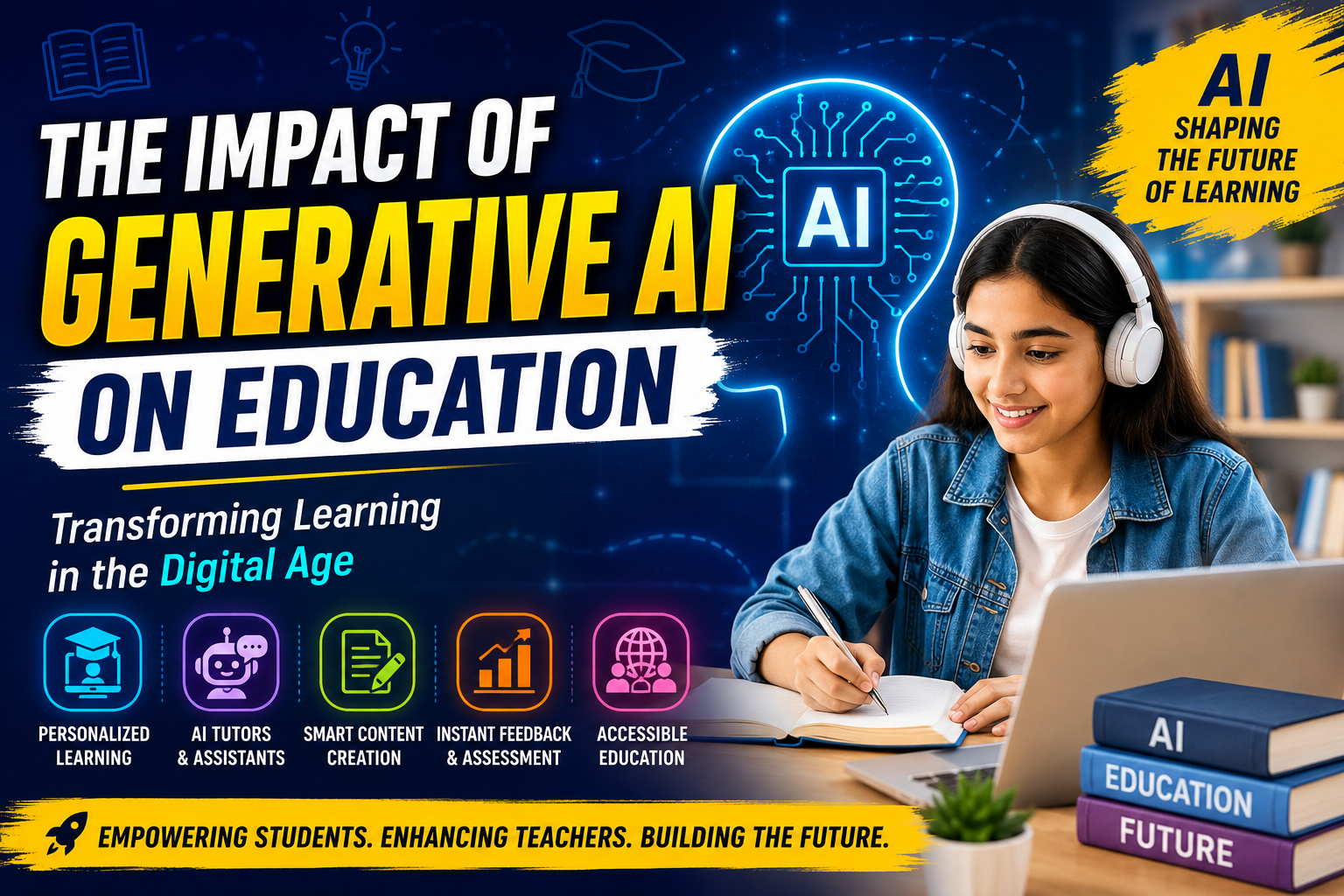
The education sector has always evolved alongside technological advancements. From chalkboards and textbooks to computers and online learning platforms, each innovation has reshaped how knowledge is delivered and consumed. Today, one of the most transformative technologies influencing education is Generative Artificial Intelligence (Generative AI). Tools such as AI-powered chatbots, content generators, virtual tutors, and personalized learning systems are revolutionizing classrooms worldwide.
Generative AI refers to artificial intelligence systems capable of creating new content, including text, images, videos, audio, and even code, based on patterns learned from vast datasets. Unlike traditional AI, which primarily analyzes information, Generative AI can generate original outputs that mimic human creativity and intelligence. As educational institutions increasingly adopt these technologies, the impact on teaching, learning, assessment, and academic administration continues to grow.
This article explores the impact of Generative AI on education, highlighting its benefits, challenges, applications, and future potential.
Understanding Generative AI in Education
Generative AI utilizes advanced machine learning models, particularly Large Language Models (LLMs), to understand and generate human-like responses. In education, these systems can assist students with learning, help teachers create instructional materials, and streamline administrative tasks.
Popular applications of Generative AI include:
- AI-powered tutoring systems
- Automated content creation
- Personalized learning experiences
- Language translation tools
- Intelligent assessment systems
- Educational chatbots
- Virtual teaching assistants
These technologies are making education more accessible, efficient, and engaging for learners worldwide.
Personalized Learning Experiences
One of the most significant advantages of Generative AI is its ability to personalize education according to individual student needs.
Traditional classrooms often follow a one-size-fits-all approach, where students learn at the same pace regardless of their abilities. However, every learner has unique strengths, weaknesses, and learning styles.
Generative AI can:
- Analyze student performance data.
- Identify knowledge gaps.
- Recommend customized learning materials.
- Adjust lesson difficulty based on progress.
- Provide individualized feedback.
For example, if a student struggles with mathematics, an AI system can generate additional practice problems, simplified explanations, and step-by-step solutions tailored to the student’s understanding level.
This personalized approach improves learning outcomes and helps students achieve their full potential.
AI-Powered Virtual Tutors
Generative AI is transforming education through intelligent virtual tutors that provide instant assistance anytime and anywhere.
Unlike human tutors, AI tutors are available 24/7 and can support millions of students simultaneously. These systems can answer questions, explain complex concepts, and guide learners through difficult subjects.
Benefits of AI tutors include:
- Immediate responses to student queries.
- Continuous availability.
- Cost-effective learning support.
- Personalized explanations.
- Interactive learning experiences.
Students can receive academic support outside classroom hours, reducing dependence on private tutoring and increasing educational accessibility.
Enhanced Content Creation for Educators
Teachers spend considerable time creating lesson plans, assignments, quizzes, presentations, and study materials. Generative AI significantly reduces this workload by automating content creation.
AI tools can generate:
- Lesson outlines
- Classroom activities
- Practice worksheets
- Multiple-choice questions
- Summaries
- Presentation content
- Educational examples
This automation allows educators to focus more on teaching, mentoring, and student engagement rather than repetitive administrative tasks.
Furthermore, teachers can quickly customize materials to suit different grade levels and learning objectives.
Improved Student Engagement
Student engagement plays a critical role in academic success. Traditional learning methods sometimes fail to maintain student interest, especially among digital-native generations.
Generative AI enhances engagement through:
Interactive Learning
AI-powered platforms can simulate conversations, role-playing exercises, and real-world scenarios.
Gamification
AI can create personalized quizzes, challenges, and educational games that make learning enjoyable.
Multimedia Content
Generative AI can produce images, videos, animations, and visual explanations that help students better understand difficult concepts.
These interactive experiences make learning more dynamic and motivating.
Language Learning and Communication
Generative AI has significantly improved language education by providing advanced language-learning tools.
Students can:
- Practice conversations with AI chatbots.
- Receive grammar corrections.
- Translate content instantly.
- Improve writing skills.
- Learn pronunciation through AI speech systems.
Language barriers that once limited educational access are becoming less significant as AI-powered translation and communication tools continue to improve.
This is especially beneficial for international students and multilingual learning environments.
Accessibility and Inclusive Education
Generative AI is helping create a more inclusive educational system by supporting students with disabilities and diverse learning needs.
Examples include:
Support for Visually Impaired Students
AI can convert text into speech and generate audio explanations.
Support for Hearing-Impaired Students
Speech-to-text systems can provide real-time captions during lectures.
Learning Assistance
Students with learning difficulties can receive personalized explanations and alternative learning formats.
By improving accessibility, Generative AI ensures that education becomes available to a broader range of learners.
Revolutionizing Assessments and Feedback
Assessment is an essential component of education, but grading assignments and providing feedback can be time-consuming.
Generative AI helps automate these processes by:
- Evaluating assignments.
- Generating performance reports.
- Providing detailed feedback.
- Identifying areas for improvement.
- Tracking learning progress.
Students benefit from immediate feedback, enabling them to correct mistakes and improve their understanding more quickly.
Teachers also gain valuable insights into student performance and learning patterns.
Supporting Research and Academic Work
Research is a critical part of higher education. Generative AI assists students and researchers in various ways.
Applications include:
- Summarizing research papers.
- Generating literature reviews.
- Organizing references.
- Identifying relevant sources.
- Assisting with academic writing.
These capabilities save time and allow researchers to focus on analysis, innovation, and critical thinking.
However, researchers must verify AI-generated information to ensure accuracy and academic integrity.
Administrative Efficiency in Educational Institutions
Beyond teaching and learning, Generative AI is improving administrative operations within educational institutions.
AI can automate tasks such as:
- Student enrollment processes.
- Schedule management.
- Attendance tracking.
- Email communication.
- Student support services.
Educational institutions can reduce operational costs and improve efficiency through AI-powered automation.
This allows administrators to devote more resources to enhancing educational quality and student services.
Challenges and Concerns
Despite its numerous benefits, Generative AI also presents several challenges that must be addressed.
Academic Integrity
Students may misuse AI tools to complete assignments, essays, and exams without genuine learning.
Educational institutions must develop policies that encourage responsible AI use while maintaining academic honesty.
Accuracy Issues
AI-generated content may sometimes contain incorrect or misleading information.
Students and educators must verify information obtained from AI systems before relying on it.
Privacy and Data Security
AI platforms often require access to user data to provide personalized experiences.
Protecting student information and ensuring compliance with privacy regulations remain important concerns.
Overdependence on Technology
Excessive reliance on AI could reduce critical thinking, creativity, and problem-solving skills among students.
Educators must strike a balance between technological assistance and independent learning.
Digital Divide
Not all students have equal access to advanced technologies and internet connectivity.
Educational institutions and governments must work to ensure equitable access to AI-powered learning tools.
Ethical Considerations
The integration of Generative AI in education raises important ethical questions.
Key considerations include:
- Transparency in AI-generated content.
- Fairness and bias prevention.
- Responsible use of student data.
- Accountability for AI-generated information.
- Ethical implementation practices.
Developers, educators, and policymakers must collaborate to establish guidelines that ensure AI benefits all learners fairly and responsibly.
The Future of Generative AI in Education
The future of education will likely involve deeper integration of Generative AI technologies.
Potential developments include:
Fully Personalized Learning Paths
AI systems may create individualized educational journeys tailored to each student’s goals, abilities, and interests.
Intelligent Virtual Classrooms
Future classrooms may feature AI teaching assistants capable of supporting both teachers and students in real time.
Advanced Simulation-Based Learning
AI-generated virtual environments could provide immersive experiences for subjects such as science, medicine, engineering, and history.
Lifelong Learning Support
Generative AI may assist individuals throughout their careers by offering continuous learning opportunities and skill development programs.
Global Education Access
AI-powered educational platforms could help deliver quality education to remote and underserved communities around the world.
As technology continues to evolve, Generative AI will play a central role in shaping the future of learning.