
Introduction
In today’s digital world, identity has become one of the most valuable assets. Every time we create a social media account, sign up for an online service, make a payment, or access government platforms, we are required to share personal information. Unfortunately, traditional identity systems rely heavily on centralized databases that store vast amounts of user data. These systems have become prime targets for cybercriminals, leading to frequent data breaches, identity theft, and privacy concerns.
As digital transformation accelerates across industries, the need for a more secure, privacy-focused, and user-controlled identity system is becoming increasingly important. This is where Decentralized Identity (DID) emerges as a revolutionary solution. Powered by blockchain technology, DID is reshaping the way individuals and organizations manage digital identities by giving users complete control over their personal information.
In 2026, Decentralized Identity is no longer just an experimental technology. Governments, financial institutions, healthcare providers, educational organizations, and Web3 platforms are actively exploring and implementing DID solutions to enhance security, privacy, and trust in digital interactions.
Understanding Decentralized Identity (DID)
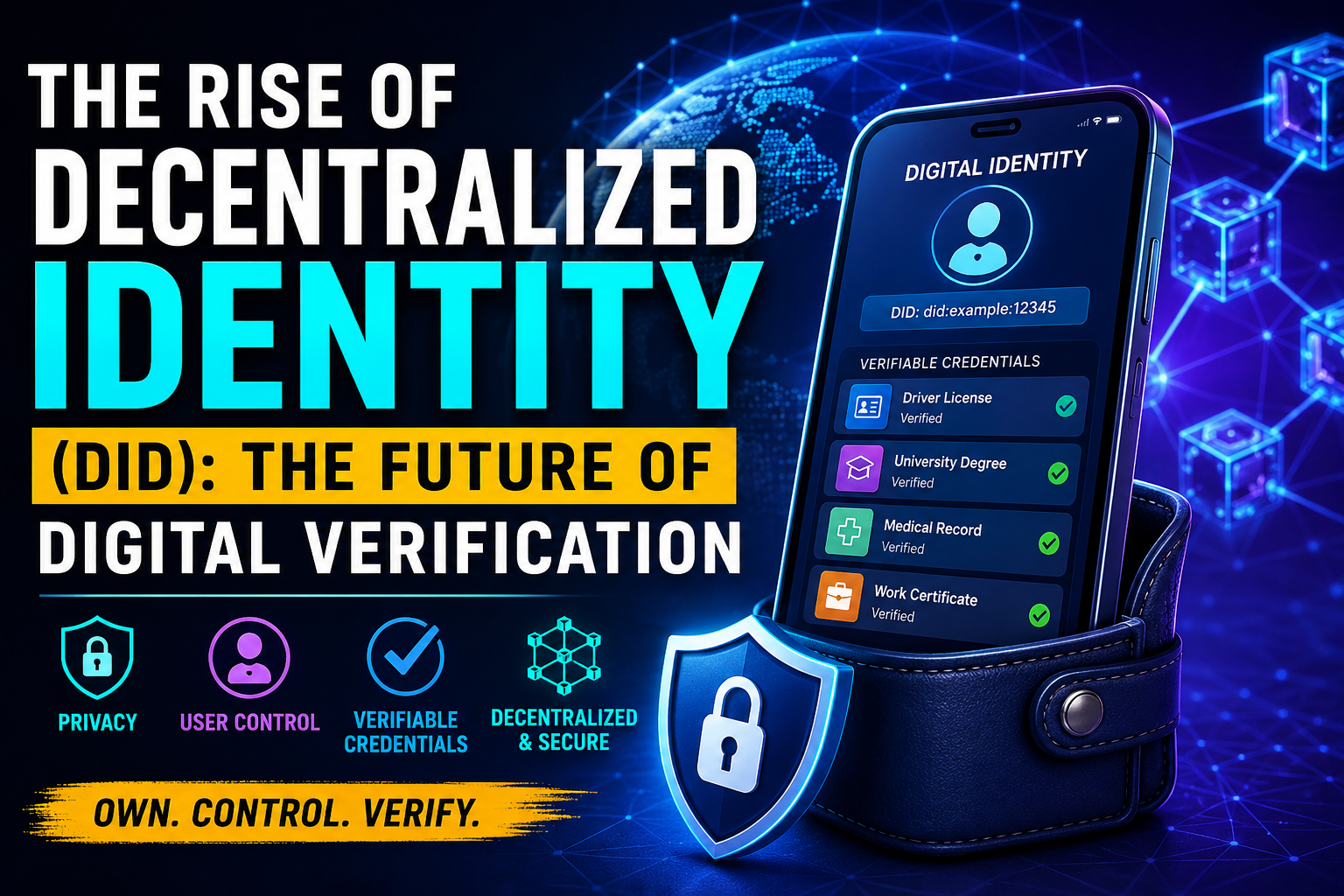
Decentralized Identity is a digital identity model that allows individuals to own, manage, and control their personal information without depending on a centralized authority.
Unlike traditional identity systems where personal data is stored by companies or government databases, DID enables users to store their credentials securely in digital wallets. Users can decide when, where, and with whom they share their information.
The DID ecosystem is built around three key components:
1. Decentralized Identifiers
A Decentralized Identifier is a unique identifier created and controlled by the user rather than a centralized organization. It acts as a digital identity reference that can be verified on a blockchain network.
2. Verifiable Credentials
Verifiable Credentials are digital versions of documents such as:
- Passports
- Driver’s licenses
- University degrees
- Employment certificates
- Medical records
- Professional licenses
These credentials are cryptographically signed, making them tamper-proof and instantly verifiable.
3. Digital Wallets
Digital wallets store identity credentials securely. Users can present proof of identity whenever needed without exposing unnecessary personal information.
Why Traditional Digital Identity Systems Are Failing
Despite technological advancements, traditional identity management systems face significant challenges.
Data Breaches
Large organizations store millions of user records in centralized databases. When these databases are hacked, sensitive information can be exposed.
High-profile data breaches over the past decade have affected billions of users worldwide, highlighting the vulnerabilities of centralized identity systems.
Identity Theft
Cybercriminals often steal personal information to commit fraud, open bank accounts, or gain unauthorized access to services.
As digital interactions increase, identity theft continues to be a growing concern.
Lack of User Control
Most online platforms collect and retain large amounts of personal data. Users often have little control over how their information is stored, shared, or monetized.
Verification Complexity
Organizations spend significant resources verifying customer identities, leading to slow onboarding processes and increased operational costs.
These limitations are driving the demand for decentralized identity solutions.
How Decentralized Identity Works
The DID framework operates on the principles of self-sovereign identity (SSI), where individuals become the owners of their digital identities.
The process typically follows these steps:
Step 1: Identity Creation
A user creates a decentralized identifier and stores it in a secure digital wallet.
Step 2: Credential Issuance
A trusted institution, such as a university or government agency, issues verifiable credentials to the user.
Step 3: Credential Storage
The credentials remain under the user’s control and are stored securely in their wallet.
Step 4: Verification Request
When a service provider needs proof of identity, the user shares only the required information.
Step 5: Instant Verification
The service provider verifies the credential’s authenticity through blockchain-based cryptographic verification.
This process eliminates the need for repeated document submissions and reduces dependency on centralized databases.
Key Benefits of Decentralized Identity
Enhanced Privacy
Users share only the minimum information required for a transaction.
For example, instead of revealing a complete date of birth, a user can simply prove that they are over 18 years old.
Improved Security
Blockchain technology and cryptographic signatures make credentials highly secure and resistant to tampering.
Since there is no central database, hackers have fewer opportunities to access large volumes of personal information.
User Ownership
Individuals maintain complete control over their digital identities and decide how their information is shared.
Reduced Fraud
Verifiable credentials significantly reduce identity fraud because credentials can be instantly authenticated.
Faster Verification
Identity verification that traditionally takes days can be completed within seconds using DID systems.
Lower Costs
Organizations can reduce expenses associated with identity verification, compliance, and document management.
Real-World Applications of DID in 2026
Financial Services
Banks and fintech companies are adopting DID solutions to streamline Know Your Customer (KYC) processes.
Customers can verify their identities instantly without repeatedly submitting documents to different institutions.
This improves customer experience while reducing operational costs.
Healthcare
Healthcare providers use decentralized identities to manage patient records securely.
Patients can grant doctors temporary access to specific medical information while maintaining privacy.
This improves data sharing between healthcare institutions and enhances patient care.
Education
Universities are issuing blockchain-based diplomas and certificates as verifiable credentials.
Employers can instantly verify academic qualifications without contacting educational institutions.
This reduces credential fraud and simplifies recruitment.
Government Services
Governments are exploring digital identity programs based on DID frameworks.
Citizens can access public services, tax systems, voting platforms, and social benefits through secure digital credentials.
Travel and Immigration
Digital passports and travel credentials are becoming more common.
Travelers can verify their identity quickly at airports and border checkpoints while maintaining privacy.
Employment Verification
Companies can issue employment credentials that allow professionals to prove work experience instantly.
Recruiters can verify qualifications without lengthy background checks.
The Role of Blockchain in DID
Blockchain serves as the foundation for decentralized identity systems.
Its key contributions include:
Immutability
Identity records cannot be altered or deleted without authorization.
Transparency
Verification processes are transparent and auditable.
Decentralization
No single organization controls the identity network.
Trust
Cryptographic verification eliminates the need for intermediaries.
Popular blockchain networks supporting DID initiatives include:
- Ethereum
- Polygon
- Solana
- Hyperledger Indy
These platforms provide the infrastructure necessary for secure identity verification.
DID and Web3
The growth of Web3 is accelerating the adoption of decentralized identity systems.
In Web3 environments, users interact directly with decentralized applications without relying on centralized platforms.
DID enables:
- Secure authentication
- Privacy-preserving interactions
- Cross-platform identity portability
- Decentralized reputation systems
- User-owned digital profiles
As Web3 ecosystems continue expanding, DID is expected to become a fundamental building block of the decentralized internet.
Challenges Facing DID Adoption
Despite its potential, decentralized identity still faces several challenges.
Regulatory Uncertainty
Governments and regulators are still developing frameworks for decentralized identity systems.
Clear regulations will be essential for widespread adoption.
User Education
Many users are unfamiliar with blockchain technology and decentralized identity concepts.
Educational initiatives will be necessary to increase adoption.
Interoperability
Different DID platforms must be able to communicate and exchange credentials seamlessly.
Industry-wide standards are being developed to address this issue.
Recovery Mechanisms
Users must have reliable methods to recover identities if wallets or credentials are lost.
Balancing security and accessibility remains a challenge.
Infrastructure Development
Widespread adoption requires robust digital infrastructure and integration with existing systems.
Emerging Trends in Decentralized Identity
Several trends are shaping the future of DID in 2026 and beyond.
AI-Powered Identity Verification
Artificial Intelligence is being combined with DID systems to improve fraud detection and automate verification processes.
Biometric Integration
Fingerprint and facial recognition technologies are being integrated with decentralized identities for stronger authentication.
Cross-Border Digital Identity
Countries are collaborating to create interoperable identity frameworks that simplify international travel and business.
Digital Credentials Economy
Individuals are beginning to manage professional achievements, certifications, memberships, and licenses through decentralized credential ecosystems.
Enterprise Adoption
Large corporations are increasingly adopting DID solutions for employee management, access control, and compliance requirements.
The Future of Digital Verification
Experts believe decentralized identity could become the standard model for digital verification within the next decade.
As cybersecurity threats continue to evolve, organizations are recognizing the limitations of centralized identity systems.
Future DID ecosystems may enable:
- Passwordless authentication
- Universal digital identities
- Secure online voting
- Trusted AI interactions
- Global identity portability
- Frictionless digital onboarding
These advancements could fundamentally transform how people interact with digital services.
Conclusion
Decentralized Identity (DID) represents one of the most significant innovations in the evolution of digital trust. By shifting control of personal information from centralized organizations to individuals, DID offers a safer, more private, and more efficient approach to identity verification.
As blockchain technology matures and adoption continues to grow, decentralized identity solutions are poised to play a critical role in finance, healthcare, education, government services, and the broader Web3 ecosystem. While challenges related to regulation, interoperability, and user education remain, the benefits of enhanced privacy, stronger security, and user empowerment make DID a compelling vision for the future.
In 2026, the rise of Decentralized Identity is no longer a distant possibility—it is becoming a reality. As digital interactions continue to expand, DID has the potential to redefine how trust is established online and create a future where individuals truly own and control their digital identities.