

In today’s digital world, data is one of e most valuable resources for businesses, governments, financial institutions, and individuals. Every day, billions of records are created, stored, updated, and transferred through digital systems. Traditional databases have been managing this data for decades, but blockchain technology has introduced a completely different approach to storing and verifying information.
This raises an important question: What is the difference between blockchain and a traditional database?
Although both technologies can store data, they are designed for different purposes. Traditional databases focus on efficient data management and centralized control, while blockchain focuses on distributed verification, transparency, and tamper-resistant records.
In this guide, we will explore Blockchain vs Traditional Databases, their key differences, advantages, disadvantages, and real-world use cases.
What Is a Traditional Database?
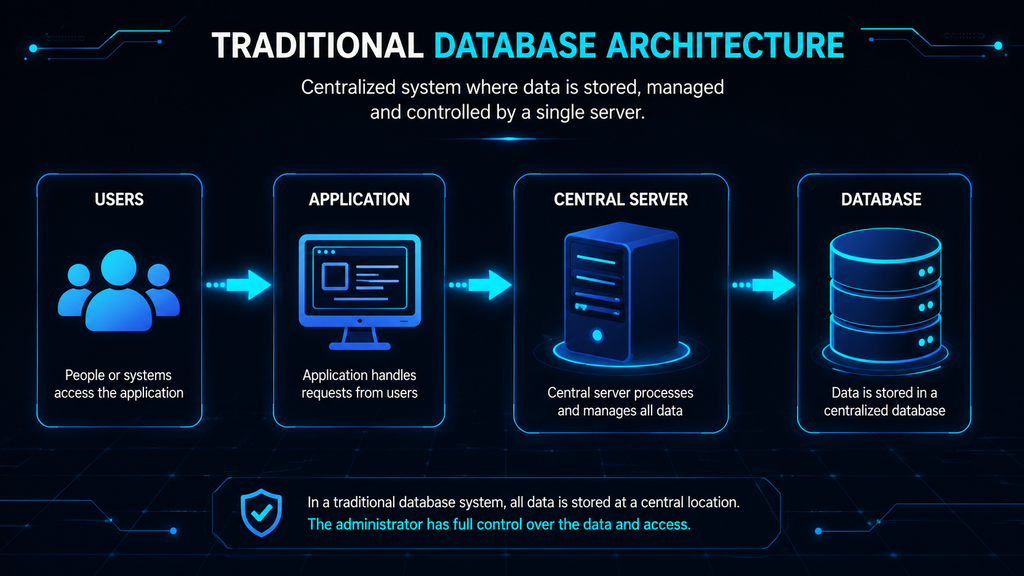
A traditional database is a structured system used to store, organize, retrieve, and manage information.
Most traditional databases are managed by a centralized organization or administrator. The organization controls who can access the database and what operations users can perform.
For example, an online shopping website may use a database to store:
- Customer information
- Product details
- Orders
- Payment records
- Inventory
- Shipping information
Popular database technologies include MySQL, PostgreSQL, Microsoft SQL Server, Oracle Database, and MongoDB.
How Does a Traditional Database Work?
A simple traditional database architecture looks like this:
User → Application → Server → Database
When a user performs an action, such as placing an order, the application sends a request to the server. The server processes the request and updates the database.
The database administrator or organization typically has control over the system.
This centralized architecture makes traditional databases fast, flexible, and relatively easy to manage.
What Is Blockchain?
Blockchain is a type of distributed ledger technology that records information in a sequence of blocks.
Instead of relying on a single central database administrator, blockchain networks can distribute copies of the ledger across multiple computers called nodes.
Each block contains information about transactions or other records and is cryptographically linked to previous blocks.
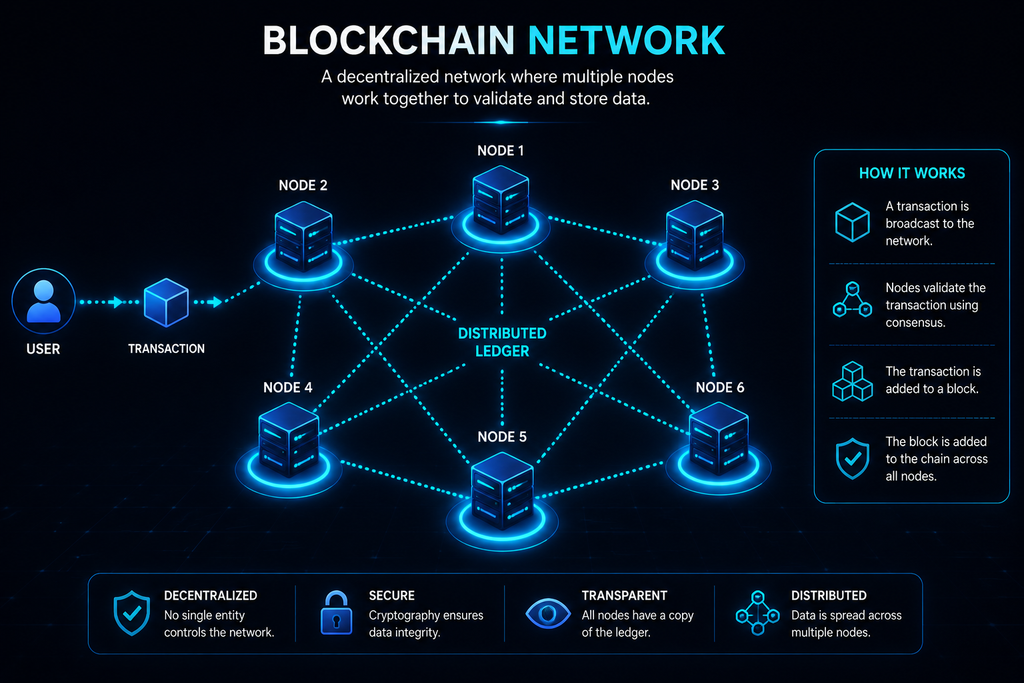
A simplified blockchain architecture looks like:
User → Blockchain Network → Multiple Nodes → Distributed Ledger
Before information is added to the blockchain, transactions are generally verified according to the network’s rules. Depending on the blockchain, this may involve a consensus mechanism such as Proof of Work or Proof of Stake.
Once confirmed, historical blockchain records are designed to be difficult to alter without detection.
Blockchain vs Traditional Database: Key Differences
Although both technologies store information, they differ in several important areas.
| Feature | Blockchain | Traditional Database |
|---|---|---|
| Architecture | Distributed | Usually centralized |
| Control | Shared/network-based | Usually controlled by an organization |
| Data modification | Difficult after confirmation | Easy for authorized users |
| Transparency | Can be publicly verifiable | Usually private |
| Speed | Often slower | Generally faster |
| Scalability | Can be challenging | Generally easier |
| Trust model | Distributed verification | Trusted administrator |
| Best use | Shared and verifiable records | General data management |
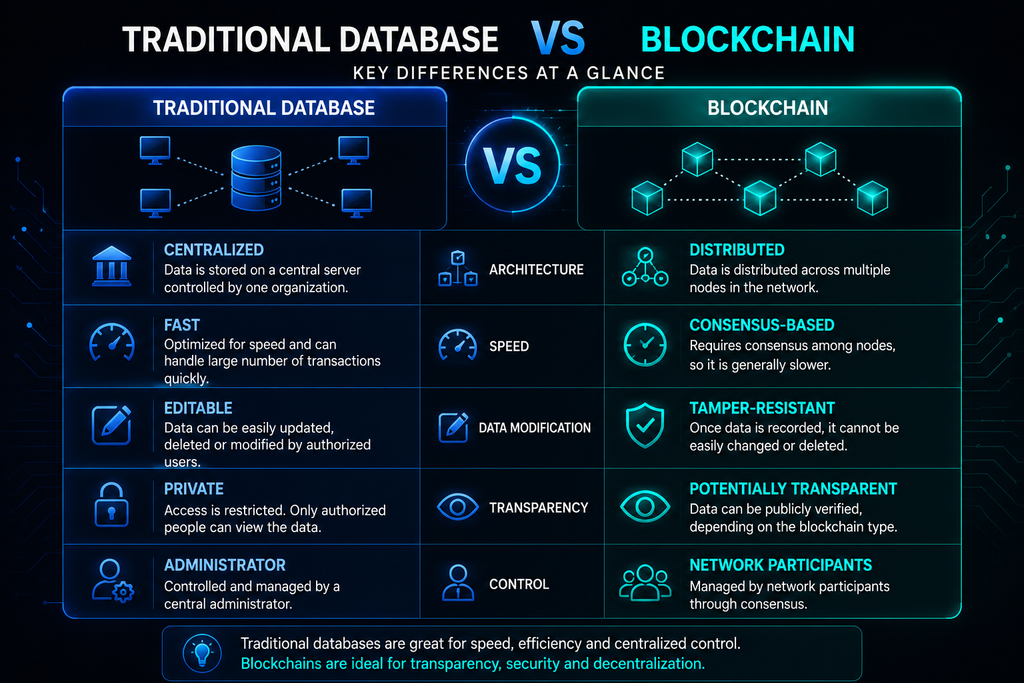
Let’s examine these differences in detail.
1. Centralization vs Decentralization
One of the biggest differences between blockchain and traditional databases is how control is organized.
Traditional databases are generally centralized. A company, government department, bank, or other organization controls the database.
For example:
Company → Central Server → Database → Users
The organization decides who can access the information and who can modify it.
Blockchain can use a distributed architecture.
Instead of storing the ledger on one central server, multiple nodes can maintain copies of the blockchain.
For example:
User → Blockchain Network → Node 1 + Node 2 + Node 3 + Node 4
This reduces dependence on a single central authority.
However, decentralization varies between blockchain networks. Public blockchains and permissioned blockchains can have very different governance models.
2. Data Modification
Traditional databases are designed to allow authorized users to modify data.
For example, if a customer changes their address, a company can update the corresponding database record.
This flexibility is extremely useful for everyday applications.
Blockchain works differently.
Once a transaction is confirmed and recorded, changing historical information can be extremely difficult. Blockchain uses cryptographic linking and network verification to protect the integrity of its history.
This property is often described as tamper resistance.
It does not mean that blockchain data can never be changed under any circumstances. Different blockchain designs can support different mechanisms, and applications built on top of blockchain can also have administrative controls.
3. Transparency
Traditional databases are usually private.
For example, a company’s internal database may only be accessible to employees and authorized systems.
Blockchain networks can provide greater transparency.
On many public blockchains, transaction information can be independently viewed and verified by participants or the public.
This can be useful when multiple parties need to verify that a transaction occurred.
However, blockchain does not automatically mean that every piece of information is public. Private and permissioned blockchain networks can restrict access.
4. Speed and Performance
Traditional databases generally have an advantage when it comes to speed.
They are designed to process large numbers of database operations efficiently. A centralized system can often process requests without requiring multiple independent nodes to reach agreement.
Blockchain networks may require additional communication and verification between nodes.
As a result, some blockchain systems may process transactions more slowly than traditional databases.
For applications such as social media, online shopping, or internal business software, a traditional database may therefore be more practical.
Blockchain is more useful when distributed verification provides an important benefit.
5. Security
Both blockchain and traditional databases can be secure when properly designed.
Traditional databases commonly use security technologies such as:
- User authentication
- Role-based access control
- Encryption
- Firewalls
- Backups
- Monitoring
- Access permissions
Blockchain uses cryptographic techniques, distributed verification, and consensus mechanisms to protect the integrity of the ledger.
However, blockchain should not be considered automatically secure.
A blockchain application can still have vulnerabilities. For example, smart contract bugs, compromised private keys, poorly designed applications, or insecure interfaces can create security risks.
Therefore, security depends on the entire system, not simply on whether blockchain is being used.
6. Scalability
Scalability refers to the ability of a system to handle increasing numbers of users, transactions, and data.
Traditional databases can be scaled using techniques such as:
- Better hardware
- Database replication
- Caching
- Load balancing
- Database sharding
- Distributed database architectures
Blockchain scalability can be more complicated.
Increasing transaction capacity while maintaining security and decentralization can create technical trade-offs.
This challenge is closely connected to the Blockchain Trilemma, which describes the difficulty of simultaneously optimizing:
Decentralization + Security + Scalability
Blockchain developers are continuously working on technologies such as Layer 2 networks, rollups, and modular architectures to improve scalability.
7. Data Ownership and Control
In a traditional database, the organization operating the database usually has significant control over the stored information.
For example, a bank controls its internal customer database.
Blockchain changes this model in certain applications.
On decentralized networks, users can interact directly with the blockchain using cryptographic wallets and digital signatures.
This can allow users to control certain digital assets without relying on a traditional intermediary.
However, blockchain does not automatically provide complete ownership of all data. Ownership and control depend on the application, network design, legal framework, and the specific asset involved.
When Should You Use a Traditional Database?
A traditional database is generally a better choice when an application requires:
- High performance
- Fast queries
- Frequent data updates
- Centralized management
- Complex data operations
- Private information
- Flexible data structures
Traditional databases are commonly used in:
- E-commerce
- Banking systems
- School management systems
- Hospital systems
- Inventory management
- Business applications
- Social media platforms
For example, an online shopping company does not necessarily need blockchain to store every customer’s shopping cart or product search.
A traditional database can usually perform these tasks more efficiently.
When Should You Use Blockchain?
Blockchain can be useful when multiple parties need to share and verify information without relying entirely on a single central authority.
Potential blockchain use cases include:
Cryptocurrency
Bitcoin and other cryptocurrencies use blockchain technology to record transactions.
Supply Chain
Blockchain can help different participants record and verify events throughout a supply chain.
Digital Assets
Blockchain can represent and transfer digital assets using tokens.
Smart Contracts
Blockchain enables smart contracts that can execute predefined logic according to the rules encoded in their programs.
Decentralized Applications
dApps can use blockchain networks as part of their backend infrastructure.
Tokenization
Real-world or digital assets can potentially be represented using blockchain-based tokens.
Can Blockchain and Traditional Databases Work Together?
Yes.
Blockchain does not have to replace traditional databases.
In fact, many applications can benefit from using both technologies.
For example, a Web3 application might use blockchain to record important transactions while storing application-specific information in a traditional database.
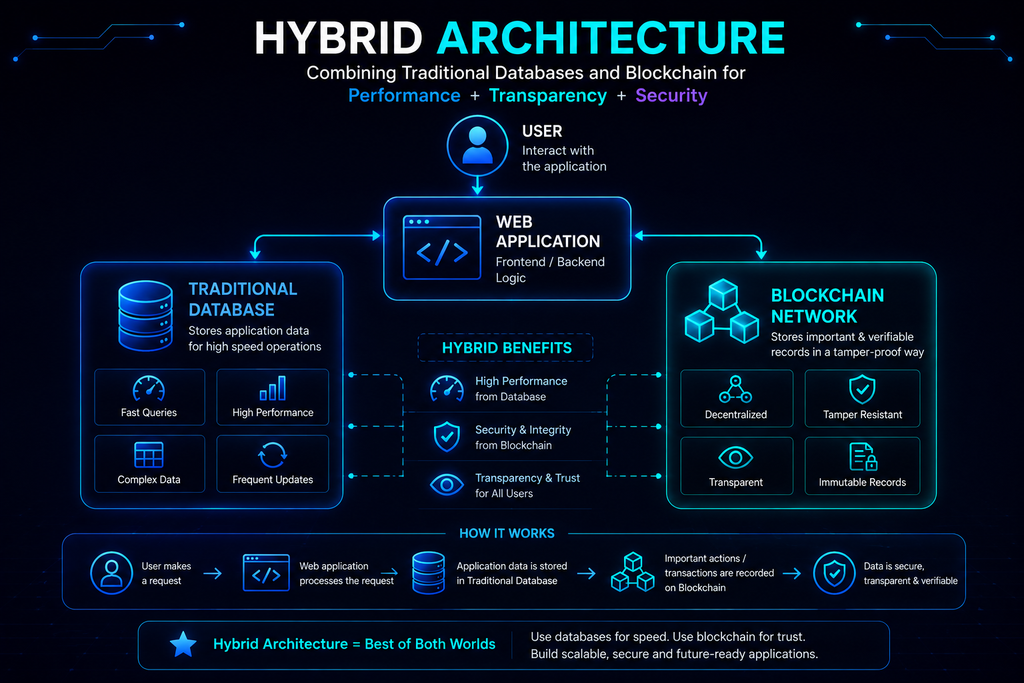
A simplified architecture could look like:
User → Web Application → Traditional Database
and:
User → Web Application → Blockchain
The traditional database can handle fast application queries, while blockchain can provide verifiable records for selected transactions.
This hybrid architecture can provide a practical balance between performance and blockchain-based verification.
Blockchain Is Not a Replacement for Every Database
One common misconception is that blockchain will eventually replace all traditional databases.
That is unlikely.
Blockchain is a specialized technology designed to solve particular problems involving distributed trust, shared records, and verifiable transactions.
Traditional databases remain extremely useful because they are fast, flexible, mature, and efficient for many applications.
The best technology depends on the requirements of the project.
Instead of asking:
“Is blockchain better than a database?”
a better question is:
“Does my application actually need blockchain?”
If there is no need for distributed verification or shared trust, a traditional database may be the better solution.
Final Thoughts
Blockchain and traditional databases are both powerful technologies, but they solve different problems.
Traditional databases are generally ideal for applications that require speed, flexibility, centralized management, and frequent data updates.
Blockchain is useful when multiple participants need a shared, verifiable, and tamper-resistant record.
Understanding the difference between these technologies is important for anyone learning about Blockchain, Web3, Crypto, Smart Contracts, and decentralized applications.
The future may not be about blockchain replacing traditional databases. Instead, we may see more applications combining both technologies to use the strengths of each.