

Blockchain technology can seem complicated at first. Terms like blocks, nodes, hashes, miners, and consensus are often used when explaining how blockchain works. But once you understand the role of just a few basic components, the whole concept becomes much easier.
Among the most important building blocks of blockchain technology are Blocks, Nodes, and Hashes.
In this guide, we will understand what these three components are, how they work together, and why they are important for blockchain security.
What Is a Blockchain?
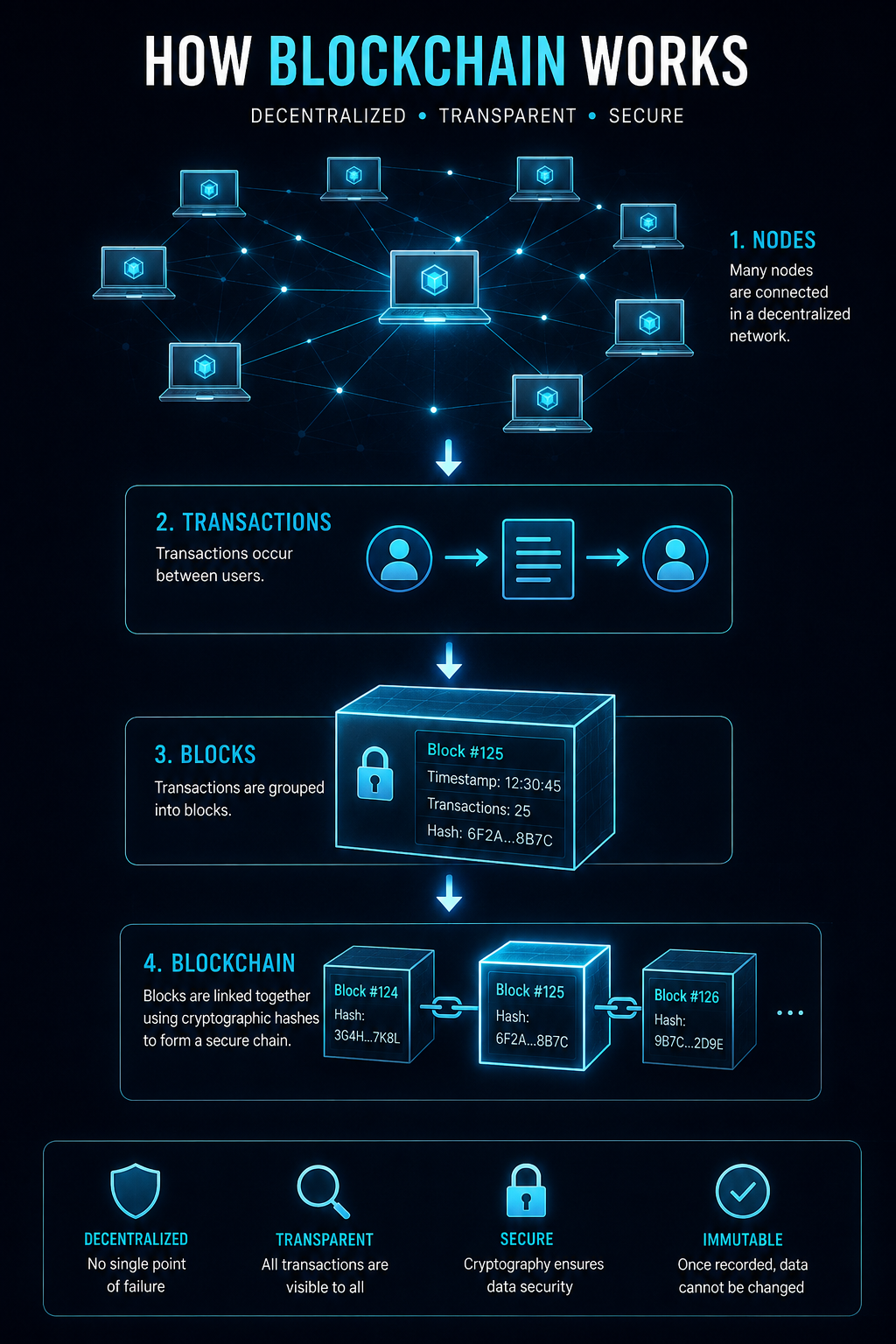
A blockchain is a type of digital ledger that stores information in a distributed network.
Unlike a traditional database where information is usually controlled by a central organization, a blockchain can distribute copies of its data across many computers called nodes.
The information is organized into groups called blocks. These blocks are connected to each other using cryptographic hashes, creating a chain of records.
This is where the name blockchain comes from:
Block + Block + Block → Blockchain
To understand this system properly, let’s look at blocks, nodes, and hashes individually.
1. What Is a Block?
A block is a collection of information stored on a blockchain.
You can think of a block like a page in a digital record book. Each page contains a group of transactions or other types of blockchain data.
For example, imagine that several people make transactions:
- Alice sends 1 coin to Bob
- Bob sends 2 coins to Charlie
- Charlie sends 0.5 coins to David
These transactions can be grouped together into a block.
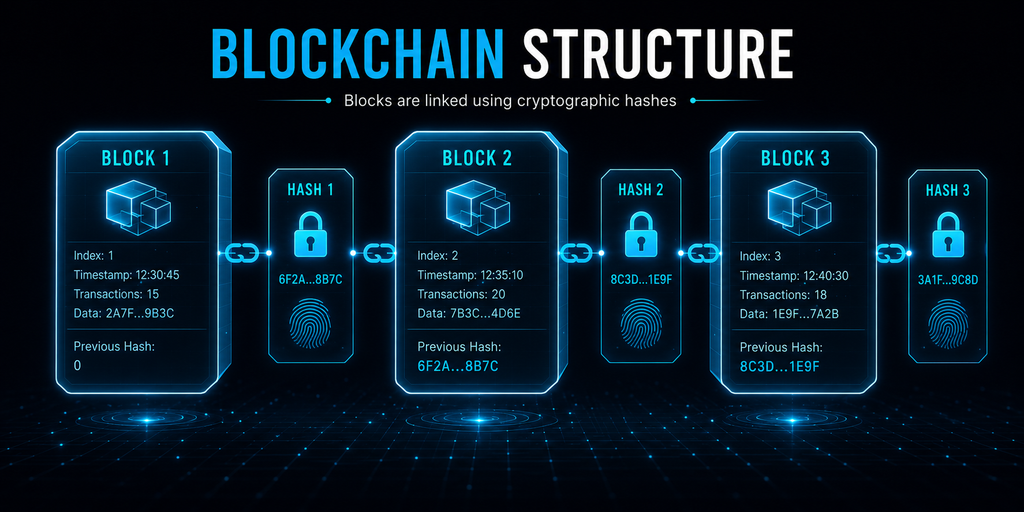
A typical blockchain block contains information such as:
- Transaction data
- Timestamp
- Block number or height
- Previous block’s hash
- Current block’s hash
- Other network-specific information
The exact structure depends on the blockchain.
Why Are Blocks Important?
Blocks allow blockchain networks to organize large amounts of information into manageable groups.
Instead of storing every transaction as an unrelated record, transactions are grouped into blocks and connected together.
This creates an ordered history of blockchain activity.
2. What Is a Node?
A node is a computer that participates in a blockchain network.
Nodes communicate with each other and may store, verify, and distribute blockchain data depending on the type of node and the blockchain’s rules.
Imagine thousands of computers connected through the internet.
Instead of one central server controlling everything, these computers work together as a network.
For example:
Node A ↔ Node B ↔ Node C ↔ Node D ↔ Node E
When new blockchain information is created, it can be shared with other participating nodes.
Types of Blockchain Nodes
Different blockchain networks use different types of nodes, but common examples include:
Full Node
A full node maintains and independently verifies blockchain data according to the network’s rules.
Light Node
A light node generally stores less data and relies on other nodes for some information.
Validator Node
In Proof-of-Stake systems, validators participate in the process of proposing or validating blocks according to the blockchain’s consensus rules.
The exact responsibilities can vary between blockchain networks.
3. What Is a Hash?
A hash is a fixed-length value generated from data using a cryptographic hash function.
You can think of it like a digital fingerprint for information.
For example, if you enter some data into a hash function, it produces a hash.
Even a tiny change in the original data can produce a completely different hash.
For example:
Data A → Hash A
Data B → Hash B
If Data A and Data B differ even slightly, their resulting hashes can be dramatically different.
This property makes cryptographic hashing extremely useful in blockchain technology.
4. How Hashes Connect Blocks
One of the most important ideas in blockchain is that blocks can reference previous blocks using their hashes.
Imagine a simple blockchain:
Block 1 → Block 2 → Block 3 → Block 4
Block 2 can contain information about the hash of Block 1.
Block 3 can contain the hash of Block 2.
Block 4 can contain the hash of Block 3.
This creates a connection between the blocks.
If someone changes information inside Block 2, the hash of Block 2 will change.
Because Block 3 references the previous block’s hash, the change can become detectable.
This is one of the important mechanisms that contributes to blockchain’s tamper-resistant design.
5. How Blocks, Nodes and Hashes Work Together
Now let’s put everything together.
Suppose Alice sends cryptocurrency to Bob.
Step 1: Transaction Is Created
Alice creates a transaction to send digital assets to Bob.
Step 2: Transaction Is Broadcast
The transaction is shared with participating blockchain nodes.
Step 3: Nodes Verify the Transaction
Nodes check whether the transaction follows the blockchain’s rules.
For example, the network may verify whether the transaction is properly authorized and whether the required conditions are satisfied.
Step 4: Transactions Are Grouped
Valid transactions can be collected into a block.
Step 5: Consensus Process
The blockchain’s consensus mechanism determines how the network agrees on the next valid block.
Different blockchains use different mechanisms, such as Proof of Work or Proof of Stake.
Step 6: Block Is Added
Once accepted according to the network’s rules, the new block becomes part of the blockchain.
Step 7: Hash Connects the Chain
The block has a cryptographic hash, and blocks reference previous block information, helping maintain the chain’s integrity.
6. Simple Real-Life Example
Imagine a school has a digital attendance book.
Every day, the attendance records are collected into one page.
That page represents a block.
Copies of the attendance book are maintained by several authorized computers.
Those computers represent nodes.
Each page gets a unique digital fingerprint based on its contents.
That fingerprint represents a hash.
If someone secretly changes an old attendance record, the fingerprint of that page changes. The connection with later pages can therefore reveal that something has been modified.
This simplified example shows the basic relationship between blocks, nodes, and hashes.
7. Why Are These Components Important?
Blocks, nodes, and hashes each have an important role.
Blocks
They organize transactions and other blockchain information into structured groups.
Nodes
They create the distributed network that stores, verifies, or communicates blockchain information.
Hashes
They provide cryptographic fingerprints that help identify data and connect blockchain records.
Together, these technologies help blockchain networks achieve properties such as data integrity, distributed verification, and tamper resistance.
8. Are Blockchain Records Completely Unchangeable?
People often say that blockchain data is “immutable.”
However, it is more accurate to say that blockchain records are generally designed to be tamper-resistant, rather than magically impossible to change.
Changing historical blockchain data can be extremely difficult because of the network’s cryptographic links, consensus rules, and distributed architecture.
The exact level of resistance depends on the blockchain’s design and security.
Blocks vs Nodes vs Hashes
| Feature | Blocks | Nodes | Hashes |
|---|---|---|---|
| What are they? | Data containers | Network computers | Cryptographic fingerprints |
| Main purpose | Store information | Participate in network | Protect/link data |
| Example | Group of transactions | Computer running blockchain software | Digital fingerprint |
| Role in blockchain | Organizes data | Verifies/distributes data | Helps maintain integrity |
Conclusion
Blocks, nodes, and hashes are three fundamental concepts that help explain how blockchain technology works.
Blocks organize transactions and other information.
Nodes participate in the distributed blockchain network.
Hashes create cryptographic fingerprints and help connect blockchain records.
When these components work together with a blockchain’s consensus mechanism, they create a distributed system that can maintain a verifiable and tamper-resistant record of information.
Understanding these three concepts is an important first step toward learning more advanced blockchain topics such as smart contracts, Proof of Stake, decentralized applications, Layer 2 networks, and Web3.
If you’re new to blockchain, don’t worry about memorizing every technical term. First understand the basic idea:
Nodes maintain the network → Transactions form blocks → Hashes help link and protect the data → Consensus helps the network agree.
That’s the foundation behind how many modern blockchain networks work.